publications
publications by categories in reversed chronological order. generated by jekyll-scholar.
2026
- Wearing Many Avatars: How Users Express, Shift and Perceive Identity Across Contexts in Social VRHongxiang Yang, Shaun Macdonald, Mohamed Khamis, and Ilyena Hirskyj-DouglasIn Proceedings of the 2026 CHI Conference on Human Factors in Computing Systems, Apr 2026
In Social Virtual Reality (VR), people use avatars to express identity. But how different social contexts influence the weighting of identity aspects people attribute to avatars, and the potential impact on avatar switching to their perception of identity consistency, remains unclear. To address this gap, our study employed a questionnaire-based survey with 100 participants. We found that people place greater emphasis on expressing their age, aesthetics and culture through avatars, relative to other identity aspects. Whereas attributes, such as one’s physical disabilities and mental health, are consistently hidden. Education and social status are context-dependent. Beyond adjusting these components, users also employed complete avatar switching as a strategy to meet social expectations and protect privacy. Furthermore, although people perceived a change in identity when switching avatars, their core identity was considered stable. This study advances knowledge of identity practices in digital spaces and offers insights for designing inclusive Social VR platforms that support multi-context identity expression.
@inproceedings{yangWearingManyAvatars2026, title = {Wearing {{Many Avatars}}: {{How Users Express}}, {{Shift}} and {{Perceive Identity Across Contexts}} in {{Social VR}}}, shorttitle = {Wearing {{Many Avatars}}}, booktitle = {Proceedings of the 2026 {{CHI Conference}} on {{Human Factors}} in {{Computing Systems}}}, author = {Yang, Hongxiang and Macdonald, Shaun and Khamis, Mohamed and {Hirskyj-Douglas}, Ilyena}, year = {2026}, month = apr, series = {{{CHI}} '26}, pages = {1--13}, publisher = {Association for Computing Machinery}, address = {New York, NY, USA}, doi = {10.1145/3772318.3790447}, urldate = {2026-08-05}, isbn = {979-8-4007-2278-3}, url = {https://dl.acm.org/doi/10.1145/3772318.3790447}, } - Augmented Urban Space: Everyday AR in Outdoor EnvironmentsOrlaith Choo, Graham Wilson, and Mark McgillACM CHI Workshop, Apr 2026
@article{chooAugmentedUrbanSpace, title = {Augmented {{Urban Space}}: {{Everyday AR}} in {{Outdoor Environments}}}, author = {Choo, Orlaith and Wilson, Graham and Mcgill, Mark}, year = {2026}, journal = {ACM CHI Workshop}, volume = {1}, number = {1}, langid = {english}, url = {https://hci.plus/wp-content/uploads/2026/04/Augmented-Urban-Space_-Everyday-AR-in-Outdoor-Environments.pdf}, } -
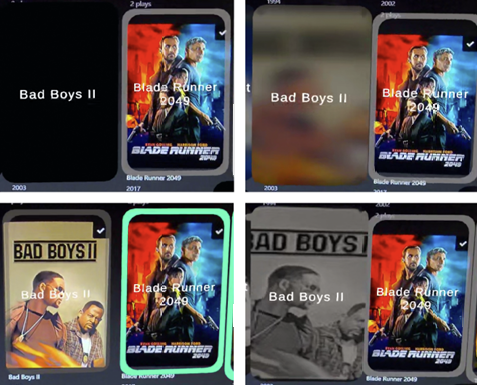 MovieMetaViewer: Extending TV Movie Browsing Interfaces to Visualise and Filter Based on Hidden or Unlinked Metadata Using Augmented Reality OverlaysCharlie Henderson, Joseph O’Hagan, Thomas Goodge, and Mark McGillIn Proceedings of the 2026 ACM International Conference on Interactive Media Experiences, Jun 2026
Streaming services do not present options neutrally. Less metadata is presented today than at the advent of streaming video, e.g. with user and critic ratings routinely hidden, inhibiting informed user choices. Our work combines Augmented Reality and Diminished Reality to explore meta-interfaces that augment TV movie browsing with additional information and perceptual filtering. We present MovieMetaViewer an AR extension for movie streaming UIs which augments streaming-service browsing with independent metadata and optional perceptual filtering. We aim to determine if such meta-interfaces are helpful during media browsing, and whether diminished reality or other visual effects can improve the browsing experience by ensuring viewers only perceive movies meeting their filtering criteria.
@inproceedings{hendersonMovieMetaViewerExtendingTV2026, title = {{{MovieMetaViewer}}: {{Extending TV Movie Browsing Interfaces}} to {{Visualise}} and {{Filter Based}} on {{Hidden}} or {{Unlinked Metadata}} Using {{Augmented Reality Overlays}}}, shorttitle = {{{MovieMetaViewer}}}, booktitle = {Proceedings of the 2026 {{ACM International Conference}} on {{Interactive Media Experiences}}}, author = {Henderson, Charlie and O'Hagan, Joseph and Goodge, Thomas and McGill, Mark}, year = {2026}, month = jun, series = {{{IMX}} '26}, pages = {456--462}, publisher = {Association for Computing Machinery}, address = {New York, NY, USA}, doi = {10.1145/3788851.3815025}, urldate = {2026-08-05}, isbn = {979-8-4007-2448-0}, url = {https://dl.acm.org/doi/full/10.1145/3788851.3815025}, } - The AI Accomplice: Exploring Generative Artificial Intelligence in Facilitating and Amplifying Deceptive DesignsThomas Kosch, Veronika Krauß, Christopher Katins, Dominik Schön, Mark McGill, and Jan GugenheimerIn Proceedings of the Extended Abstracts of the 2026 CHI Conference on Human Factors in Computing Systems, Apr 2026
As generative Artificial Intelligence (AI) becomes increasingly embedded and utilized for digital design, it presents both opportunities and risks. One major concern is its potential to facilitate and incorporate deceptive design patterns into computing technologies, which could manipulate or mislead users to their disadvantage. Similar to the concept of precedent-based design, a common approach in design theory that suggests reapplying previous design solutions to similar or identical problems, generative AI can integrate deceptive design patterns included in the training data a model has seen before. Our workshop explores how generative AI suggests and enacts deceptive design patterns in digital design. The goal of the workshop is to explore the ethical challenges of utilizing generative AI models and develop strategies to detect or prevent manipulative practices, thereby creating more transparent and equitable AI-generated experiences.
@inproceedings{koschAIAccompliceExploring2026a, title = {The {{AI Accomplice}}: {{Exploring Generative Artificial Intelligence}} in {{Facilitating}} and {{Amplifying Deceptive Designs}}}, shorttitle = {The {{AI Accomplice}}}, booktitle = {Proceedings of the {{Extended Abstracts}} of the 2026 {{CHI Conference}} on {{Human Factors}} in {{Computing Systems}}}, author = {Kosch, Thomas and Krau{\ss}, Veronika and Katins, Christopher and Sch{\"o}n, Dominik and McGill, Mark and Gugenheimer, Jan}, year = {2026}, month = apr, series = {{{CHI EA}} '26}, pages = {1--4}, publisher = {Association for Computing Machinery}, address = {New York, NY, USA}, doi = {10.1145/3772363.3778770}, urldate = {2026-08-05}, isbn = {979-8-4007-2281-3}, url = {https://dl.acm.org/doi/full/10.1145/3772363.3778770}, } -
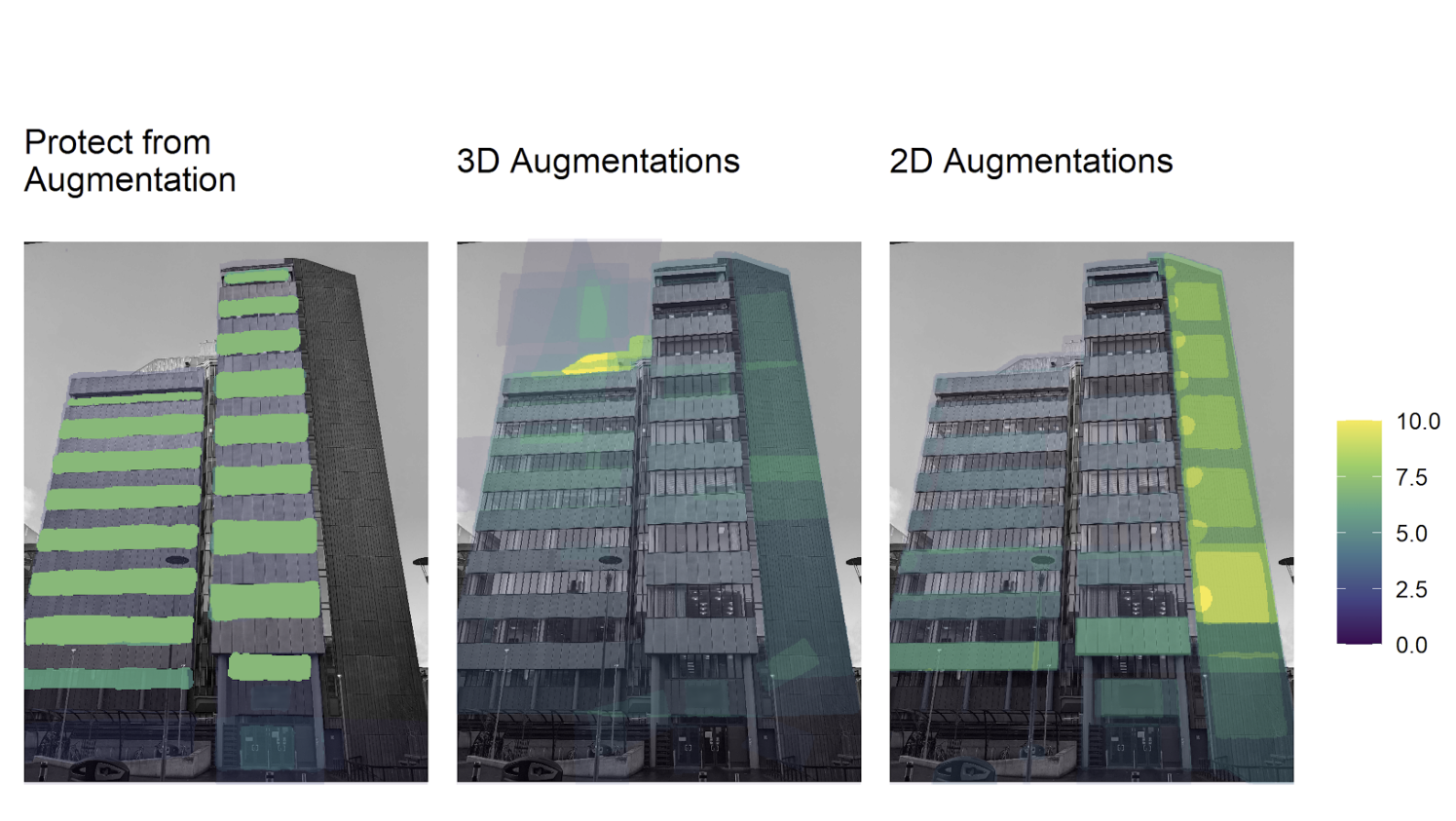 The BrutARlist: Exploring How and Why Individuals Alter a Known Brutalist Building with Augmented RealityJoseph O’Hagan, Graham Wilson, Thomas Goodge, Diego Drago, and Mark McGillIn Proceedings of the 2026 International Conference on Advanced Visual Interfaces, Jun 2026
Buildings, which people encounter continuously in their day-to-day life, are a compelling target for augmented reality (AR), being fixed, static structures often with plain, flat surfaces to use as potential canvases for AR content. We present a user study (n=15) where participants described how they would augment a Brutalist building they see/use often with AR content. Our results show a willingness to augment the building aesthetically and functionally We identify preliminary insights on where augmentations on buildings are preferred to be made, i.e. targeting flat, empty surfaces and the roof, avoiding windows and entrances.
@inproceedings{ohaganBrutARlistExploringHow2026, title = {The {{BrutARlist}}: {{Exploring How}} and {{Why Individuals Alter}} a {{Known Brutalist Building}} with {{Augmented Reality}}}, shorttitle = {The {{BrutARlist}}}, booktitle = {Proceedings of the 2026 {{International Conference}} on {{Advanced Visual Interfaces}}}, author = {O'Hagan, Joseph and Wilson, Graham and Goodge, Thomas and Drago, Diego and McGill, Mark}, year = {2026}, month = jun, series = {{{AVI}} '26}, pages = {1--5}, publisher = {Association for Computing Machinery}, address = {New York, NY, USA}, doi = {10.1145/3811427.3811475}, urldate = {2026-08-05}, isbn = {979-8-4007-2342-1}, url = {https://dl.acm.org/doi/full/10.1145/3811427.3811475}, } -
 Wearable, Everyday AI+Augmented Reality: Perceptual Mediation, Harms, and GovernanceJoseph O’Hagan, Thomas Goodge, Graham Wilson, Jan Gugenheimer, Orlaith Choo, and Mark McGillHuman Rights in Immersive Realities (XR): Freedom of Expression, Justice, Children’s Rights and Well-Being, Jun 2026
@article{ohaganWearableEverydayAI+Augmented, title = {Wearable, {{Everyday AI}}+{{Augmented Reality}}: {{Perceptual Mediation}}, {{Harms}}, and {{Governance}}}, author = {O'Hagan, Joseph and Goodge, Thomas and Wilson, Graham and Gugenheimer, Jan and Choo, Orlaith and McGill, Mark}, year = {2026}, journal = {Human Rights in Immersive Realities (XR): Freedom of Expression, Justice, Children's Rights and Well-Being}, publisher = {{European Metaverse Research Network and Council of Europe}}, langid = {english}, url = {https://www.coe.int/en/web/freedom-expression/human-rights-in-immersive-realities-xr-freedom-of-expression-justice-children-s-rights-and-well-being?}, } -
 WebPerceptor: An Open Source Chromium Plugin for Real-Time LLM-Based In-Line, In-Browser Re-Writing of Website ContentJoseph O’Hagan, Graham Wilson, and Mark McGillIn Proceedings of the Extended Abstracts of the 2026 CHI Conference on Human Factors in Computing Systems, Apr 2026
We introduce the "AI Mediated Web", an automatic, personalised, in-line, real-time remixing of web content by an LLM based on given prompts and presented in-browser such that the user perceives the end result as a published web page. We present WebPerceptor an open source, client-side Chromium plugin which, for any webpage, identifies text content, relays this to a local or cloud-based LLM with a user-defined prompt and then modifies the existing text (to replace, append, or remove it) based on the LLM response. We discuss the potential benefits and harms of an AI mediated web where the idea of a shared, canonical, objective web will no longer hold as AI becomes the mediator of what we perceive when we browse online.
@inproceedings{ohaganWebPerceptorOpenSource2026, title = {{{WebPerceptor}}: {{An Open Source Chromium Plugin}} for {{Real-Time LLM-Based In-Line}}, {{In-Browser Re-Writing}} of {{Website Content}}}, shorttitle = {{{WebPerceptor}}}, booktitle = {Proceedings of the {{Extended Abstracts}} of the 2026 {{CHI Conference}} on {{Human Factors}} in {{Computing Systems}}}, author = {O'Hagan, Joseph and Wilson, Graham and McGill, Mark}, year = {2026}, month = apr, series = {{{CHI EA}} '26}, pages = {1--5}, publisher = {Association for Computing Machinery}, address = {New York, NY, USA}, doi = {10.1145/3772363.3798730}, urldate = {2026-08-05}, isbn = {979-8-4007-2281-3}, url = {https://dl.acm.org/doi/full/10.1145/3772363.3798730}, } -
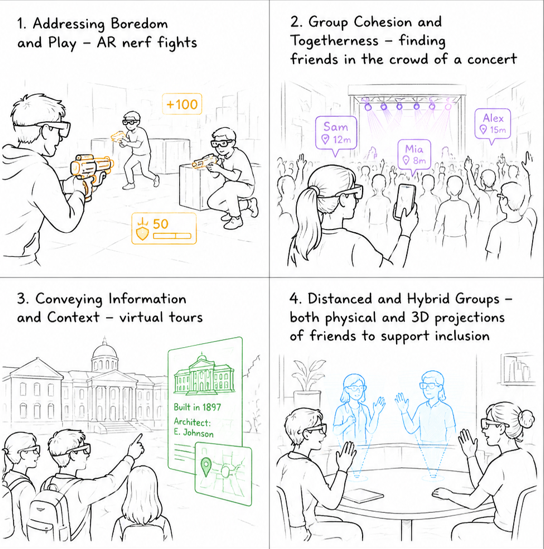 Exploring the Social Challenges and Opportunities of Group Use of Augmented Reality Through Speculative Design WorkshopsDaniel Gyorgy Szittya, Joseph O’Hagan, Katharina Margareta Theresa Pöhlmann, Graham Wilson, and Mark McGillIn Proceedings of the 2026 ACM International Conference on Interactive Media Experiences, Jun 2026
With augmented reality (AR) soon expected become part of our everyday lives there is a pertinent need to consider how it should be used within social settings. We explore individuals’ inclinations towards incorporating AR into small group social interactions across a diverse range of settings. Through six speculative design focus groups involving 21 participants, 100 ideas were generated across three scenarios: living room settings (public – sociopetal), public transport seating (semi-public – mixed proxemics), and crowded public spaces (public – sociofugal). We discuss the challenges being addressed through the proposed social AR designs, ranging from functional use cases around conveying shared information and supporting group cohesion, to addressing boredom, to facilitating shared imagination.
@inproceedings{szittyaExploringSocialChallenges2026, title = {Exploring the {{Social Challenges}} and {{Opportunities}} of {{Group Use}} of {{Augmented Reality Through Speculative Design Workshops}}}, booktitle = {Proceedings of the 2026 {{ACM International Conference}} on {{Interactive Media Experiences}}}, author = {Szittya, Daniel Gyorgy and O'Hagan, Joseph and Margareta Theresa P{\"o}hlmann, Katharina and Wilson, Graham and McGill, Mark}, year = {2026}, month = jun, series = {{{IMX}} '26}, pages = {479--489}, publisher = {Association for Computing Machinery}, address = {New York, NY, USA}, doi = {10.1145/3788851.3815029}, urldate = {2026-08-05}, isbn = {979-8-4007-2448-0}, url = {https://dl.acm.org/doi/abs/10.1145/3788851.3815029}, } -
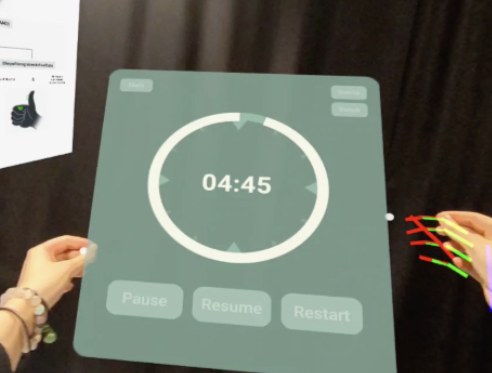 Time WizARd: Exploring the Use of Augmented Reality for Supporting Multitask Timekeeping in Kitchen CookingJoseph O’Hagan, Xinuo Zhou, Katharina Margareta Theresa Pöhlmann, and Mark McGillIn Proceedings of the 2026 International Conference on Advanced Visual Interfaces, Jun 2026
Augmented reality (AR) can aid individuals during complex, time sensitive tasks like cooking. To explore AR’s use within the kitchen we conducted an interview study (N=17) and identified time management, due to the constraints of single-device timers such as smartphones, as a challenge whilst cooking which AR could address. We conducted a user study (N=14) comparing an AR spatial timer, which allows multiple instances of timers to be positioned within a culinary environment, with a single device timer for workload perception and time management efficiency. Our results show spatial-timers can assist users by making it easier to check remaining time for specific kitchen station, and can more effectively draw attention to stations, but overall workload did not improve.
@inproceedings{ohaganTimeWizARdExploring2026, title = {Time {{WizARd}}: {{Exploring}} the {{Use}} of {{Augmented Reality}} for {{Supporting Multitask Timekeeping}} in {{Kitchen Cooking}}}, shorttitle = {Time {{WizARd}}}, booktitle = {Proceedings of the 2026 {{International Conference}} on {{Advanced Visual Interfaces}}}, author = {O'Hagan, Joseph and Zhou, Xinuo and P{\"o}hlmann, Katharina Margareta Theresa and McGill, Mark}, year = {2026}, month = jun, series = {{{AVI}} '26}, pages = {1--5}, publisher = {Association for Computing Machinery}, address = {New York, NY, USA}, doi = {10.1145/3811427.3811474}, urldate = {2026-08-05}, isbn = {979-8-4007-2342-1}, url = {https://dl.acm.org/doi/full/10.1145/3811427.3811474}, } -
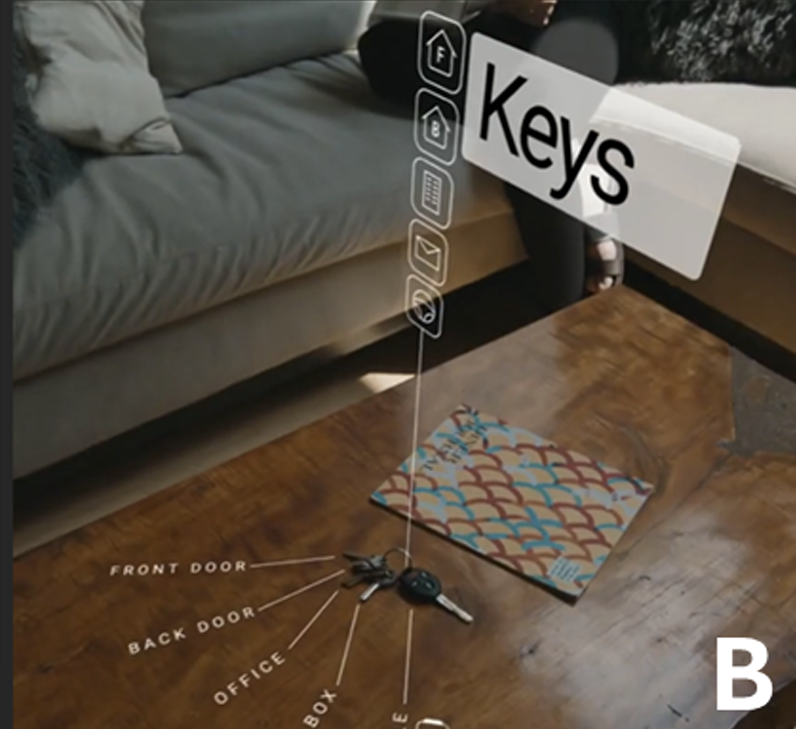 Towards Responsible Memory Augmentation: Surveying the Intended Uses of Everyday Augmented Reality and Artificial Intelligence for Memory ProcessesGraham Wilson, Thomas Goodge, Joseph O’Hagan, and Mark McGillIn Proceedings of the Augmented Humans International Conference 2026, May 2026
With the advent of everyday Augmented Reality (AR) glasses the public will be able to receive personalised and context-relevant spatial information displays driven by complex Artificial Intelligence (AI) processes. Research on other everyday technologies shows that use can lead to beneficial or detrimental effects on human memory, depending on the use case or individual. Therefore, it is imperative to understand how everyday AR+AI might be used for memory purposes ahead of time, to ensure the creation of responsible memory augmentations: maximising benefits whilst minimising harms. Through a survey (N=120) we captured how likely respondents would be to use AR+AI devices for a list of 25 memory purposes derived from the literature and commercial materials. Our results predict frequent, pervasive and varied use of AR+AI across memory types, and that individual differences predict specific constellations or patterns of use. We provide recommendations for research areas that academia, industry and policymakers should prioritise.
@inproceedings{wilsonResponsibleMemoryAugmentation2026a, title = {Towards {{Responsible Memory Augmentation}}: {{Surveying}} the {{Intended Uses}} of {{Everyday Augmented Reality}} and {{Artificial Intelligence}} for {{Memory Processes}}}, shorttitle = {Towards {{Responsible Memory Augmentation}}}, booktitle = {Proceedings of the {{Augmented Humans International Conference}} 2026}, author = {Wilson, Graham and Goodge, Thomas and O'Hagan, Joseph and McGill, Mark}, year = {2026}, month = may, series = {{{AHs}} '26}, pages = {153--166}, publisher = {Association for Computing Machinery}, address = {New York, NY, USA}, doi = {10.1145/3795011.3795018}, urldate = {2026-08-05}, isbn = {979-8-4007-2351-3}, url = {https://dl.acm.org/doi/full/10.1145/3795011.3795018}, } -
 What Role(s) Will GenAI Play in Human Memory? Cognitive Theories for the Design of Responsible “Tools For Memory”Graham Wilson, Thomas Goodge, Joseph O’Hagan, and Mark McGillIn ACM CHI Workshop on Tools for Thought, May 2026
@inproceedings{wilsonWhatRolesWill2026, title = {What {{Role}}(s) {{Will GenAI Play}} in {{Human Memory}}? {{Cognitive Theories}} for the {{Design}} of {{Responsible}} ``{{Tools For Memory}}''}, booktitle = {{{ACM CHI Workshop}} on {{Tools}} for {{Thought}}}, author = {Wilson, Graham and Goodge, Thomas and O'Hagan, Joseph and McGill, Mark}, year = {2026}, langid = {english}, url = {https://ai-tools-for-thought.github.io/workshop/}, }


2025
- "What You Think Is Private Is No Longer" - Investigating the Aftermath of Shoulder Surfing on Smartphones in Everyday Life through the Eyes of the VictimsHabiba Farzand, Shaun Macdonald, Karola Marky, and Mohamed KhamisIn Proceedings of the 24th International Conference on Mobile and Ubiquitous Multimedia, Nov 2025
This paper investigates how experiencing shoulder surfing impacts smartphone users: Through an in-depth survey in the UK (N=91), we specifically investigate how shoulder surfing affects (a) the privacy perceptions of victim users and (b) their interactions with smartphones. We found that the impact of being shoulder-surfed is highly individual. First, shoulder surfing is perceived as unavoidable and frequently occurring, leading to an increased time to complete tasks. Second, users are concerned about their own and other people’s privacy and even consider shoulder surfing a gateway to more serious threats (e.g., identity or device theft). Users are willing to alter their behaviour and use software-based protective measures to prevent shoulder surfing. Finally, we captured a set of user-defined criteria essential to software-based protective measures. Based on our results, we discuss future work directions for user-centred shoulder surfing mitigation.
@inproceedings{farzandWhatYouThink2025, title = {"{{What}} You Think Is Private Is No Longer" - {{Investigating}} the {{Aftermath}} of {{Shoulder Surfing}} on {{Smartphones}} in {{Everyday Life}} through the {{Eyes}} of the {{Victims}}}, booktitle = {Proceedings of the 24th {{International Conference}} on {{Mobile}} and {{Ubiquitous Multimedia}}}, author = {Farzand, Habiba and Macdonald, Shaun and Marky, Karola and Khamis, Mohamed}, year = {2025}, month = nov, series = {{{MUM}} '25}, pages = {209--221}, publisher = {Association for Computing Machinery}, address = {New York, NY, USA}, doi = {10.1145/3771882.3771900}, urldate = {2026-08-05}, isbn = {979-8-4007-2015-4}, url = {https://dl.acm.org/doi/10.1145/3771882.3771900}, } -
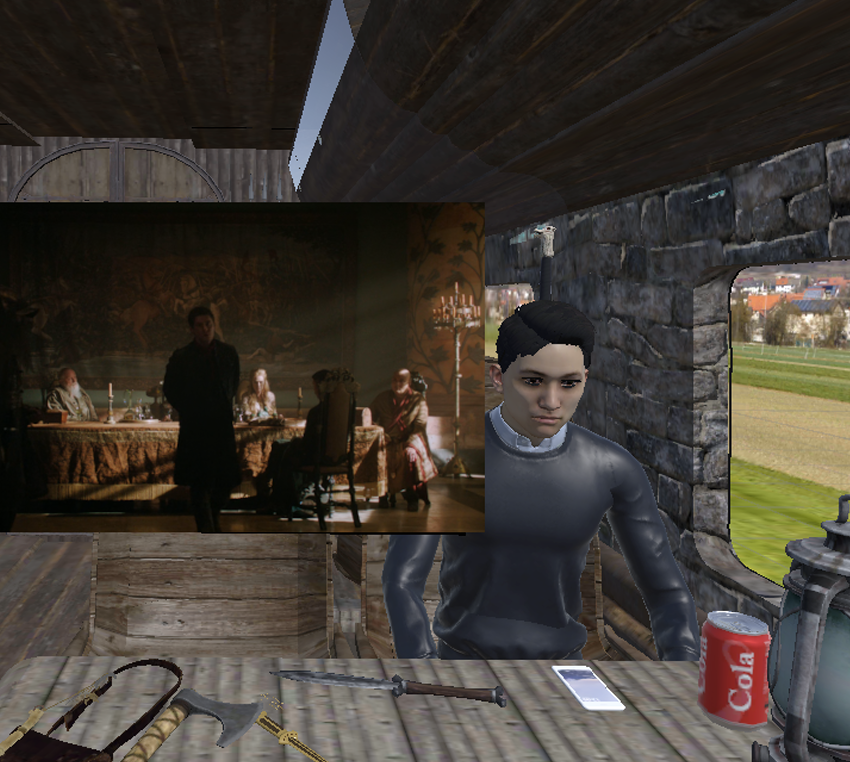 Winter Is Coming… To Your Commute: Adapting Passenger ARTV Ornamentations to Match On-screen Visuals For Enhanced Immersion in Fantasy Drama TV ContentIain Christie, Graham Wilson, Mark McGill, and Stephen Anthony BrewsterIn Proceedings of the 2025 ACM International Conference on Interactive Media Experiences, May 2025
Augmented Reality Television (ARTV) affords new ways to experience media – from displaying auxiliary information to increasing immersion with additional 3D models. Many people consume video content when travelling or commuting; accordingly, the benefits of ARTV in this context merit investigation. We conducted a study (N=20) exploring the effects of using ARTV Ornamentations when watching Game of Thrones on a train. We used Virtual Reality to simulate use of AR in a train carriage and evaluated four different levels of ARTV Ornamentation, from a simple floating panel through to themed models and interior textures that change to match the on-screen visuals. Results showed that Ornamentations matching the show’s genre were sufficient to provide an engaging and immersive experience, but Ornamentations themed to the show which changed based on the scene further elevated the experience. This means it is possible for passengers to have an immersive experience while commuting without significantly reducing their awareness of their environment. We also reflect on the implications of our work for an existing ARTV framework and propose the inclusion of several new aspects to encourage designers to consider the unique challenges and affordances of ARTV Ornamentations.
@inproceedings{christieWinterComingYour2025, title = {Winter Is {{Coming}}\dots{} {{To Your Commute}}: {{Adapting Passenger ARTV Ornamentations}} to {{Match On-screen Visuals For Enhanced Immersion}} in {{Fantasy Drama TV Content}}}, shorttitle = {Winter Is {{Coming}}\dots{} {{To Your Commute}}}, booktitle = {Proceedings of the 2025 {{ACM International Conference}} on {{Interactive Media Experiences}}}, author = {Christie, Iain and Wilson, Graham and McGill, Mark and Brewster, Stephen Anthony}, year = {2025}, month = may, series = {{{IMX}} '25}, pages = {275--293}, publisher = {Association for Computing Machinery}, address = {New York, NY, USA}, doi = {10.1145/3706370.3727854}, urldate = {2026-02-06}, isbn = {979-8-4007-1391-0}, url = {https://dl.acm.org/doi/full/10.1145/3706370.3727854}, } - [DC] AR in the Moment: Ethics and Impact of Real-Time Social Support ToolsZayne KadryIn 2025 IEEE International Symposium on Mixed and Augmented Reality Adjunct (ISMAR-Adjunct), Oct 2025
As Augmented Reality (AR) becomes more embedded in daily life, it holds the potential to support users in navigating socially challenging situations. This PhD proposes to explore how AR can assist with real-time interpersonal interactions, such as meeting new people, while also examining the unintended consequences and ethical risks of such tools. Through surveys, co-design workshops, and hands-on user studies, the project investigates both user needs and the broader social impact of socially assistive AR. By balancing practical design with critical inquiry, this work aims to contribute ethical guidelines and reflective tools for assessing AR systems that are not only effective, but also responsible and inclusive.
@inproceedings{kadryDCARMoment2025, title = {[{{DC}}] {{AR}} in the {{Moment}}: {{Ethics}} and {{Impact}} of {{Real-Time Social Support Tools}}}, shorttitle = {[{{DC}}] {{AR}} in the {{Moment}}}, booktitle = {2025 {{IEEE International Symposium}} on {{Mixed}} and {{Augmented Reality Adjunct}} ({{ISMAR-Adjunct}})}, author = {Kadry, Zayne}, year = {2025}, month = oct, pages = {1014--1015}, issn = {2771-1110}, doi = {10.1109/ISMAR-Adjunct68609.2025.00295}, urldate = {2026-02-06}, keywords = {Augmented reality,Ethics,Guidelines,Iterative methods,Medical services,Navigation,Psychology,Real-time systems,Social interaction,Surveys,User experience}, url = {https://ieeexplore.ieee.org/abstract/document/11236350}, } -
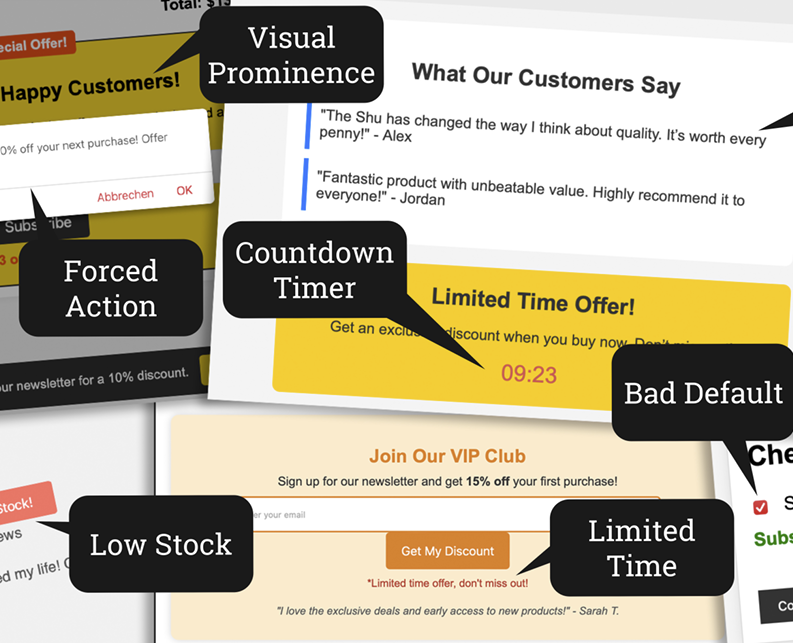 "Create a Fear of Missing Out" - ChatGPT Implements Unsolicited Deceptive Designs in Generated Websites Without WarningVeronika Krauß, Mark McGill, Thomas Kosch, Yolanda Maira Thiel, Dominik Schön, and Jan GugenheimerIn Proceedings of the 2025 CHI Conference on Human Factors in Computing Systems, Apr 2025
With the recent advancements in Large Language Models (LLMs), web developers increasingly apply their code-generation capabilities to website design. However, since these models are trained on existing designerly knowledge, they may inadvertently replicate bad or even illegal practices, especially deceptive designs (DD). This paper examines whether users can accidentally create DD for a fictitious webshop using GPT-4. We recruited 20 participants, asking them to use ChatGPT to generate functionalities (product overview or checkout) and then modify these using neutral prompts to meet a business goal (e.g., “increase the likelihood of us selling our product”). We found that all 20 generated websites contained at least one DD pattern (mean: 5, max: 9), with GPT-4 providing no warnings. When reflecting on the designs, only 4 participants expressed concerns, while most considered the outcomes satisfactory and not morally problematic, despite the potential ethical and legal implications for end-users and those adopting ChatGPT’s recommendations.
@inproceedings{kraussCreateFearMissing2025, title = {"{{Create}} a {{Fear}} of {{Missing Out}}" - {{ChatGPT Implements Unsolicited Deceptive Designs}} in {{Generated Websites Without Warning}}}, booktitle = {Proceedings of the 2025 {{CHI Conference}} on {{Human Factors}} in {{Computing Systems}}}, author = {Krau{\ss}, Veronika and McGill, Mark and Kosch, Thomas and Thiel, Yolanda Maira and Sch{\"o}n, Dominik and Gugenheimer, Jan}, year = {2025}, month = apr, series = {{{CHI}} '25}, pages = {1--20}, publisher = {Association for Computing Machinery}, address = {New York, NY, USA}, doi = {10.1145/3706598.3713083}, urldate = {2026-02-06}, isbn = {979-8-4007-1394-1}, url = {https://dl.acm.org/doi/full/10.1145/3706598.3713083}, } - Do We Need Responsible XR? Drawing on Responsible AI to Inform Ethical Research and Practice into XRAI / the MetaverseMark McGill, Joseph O’Hagan, Thomas Goodge, Graham Wilson, Mohamed Khamis, Veronika Krauß, and Jan GugenheimerApr 2025
This position paper for the CHI 2025 workshop "Everyday AR through AI-in-the-Loop" reflects on whether as a field HCI needs to define Responsible XR as a parallel to, and in conjunction with, Responsible AI, addressing the unique vulnerabilities posed by mass adoption of wearable AI-enabled AR glasses and XR devices that could enact AI-driven human perceptual augmentation.
@misc{mcgillWeNeedResponsible2025, title = {Do {{We Need Responsible XR}}? {{Drawing}} on {{Responsible AI}} to {{Inform Ethical Research}} and {{Practice}} into {{XRAI}} / the {{Metaverse}}}, shorttitle = {Do {{We Need Responsible XR}}?}, author = {McGill, Mark and O'Hagan, Joseph and Goodge, Thomas and Wilson, Graham and Khamis, Mohamed and Krau{\ss}, Veronika and Gugenheimer, Jan}, year = {2025}, month = apr, number = {arXiv:2504.04440}, eprint = {2504.04440}, primaryclass = {cs}, publisher = {arXiv}, doi = {10.48550/arXiv.2504.04440}, urldate = {2026-02-06}, archiveprefix = {arXiv}, keywords = {Computer Science - Artificial Intelligence,Computer Science - Human-Computer Interaction}, url = {https://arxiv.org/abs/2504.04440}, } - “Everyone Knows You’re Watching P*rn”: Reflecting on First-Hand User Accounts on the Use and Public Perception of in-Transit Passenger XRKatharina M. T. Pöhlmann, Graham Wilson, Laura Bajorunaite, Mark McGill, and Joseph O’HaganIn 2025 IEEE International Symposium on Mixed and Augmented Reality (ISMAR), Oct 2025
AR/VR use in-transit is increasing due to the advantages it provides over more limited mobile and seatback displays for work and play. However, despite the now common support for “travel mode” in consumer XR headsets such as the Meta Quest 3 and Apple Vision Pro, little is known about how this emergent technology has been used in-practice by passengers - from why and how they use it, to what real-world challenges they face during usage in these very public, shared contexts. To address this gap, we contribute a novel large scale analysis of Reddit posts discussing first-hand use of VR/AR in-transit. We captured 11,150 posts, producing 437 user accounts which were synthesized into themes in relation to: in-the-wild use of immersive devices, users’ positive/negative sentiment about usage, challenges they faced, and social interactions and impediments that occurred. Our snapshot of the current reality of passenger XR provides real-world insight evidencing the need for more passenger-centric designs of spatial interfaces, interaction techniques, and reality awareness.
@inproceedings{pohlmannEveryoneKnowsYoure2025, title = {``{{Everyone Knows You}}'re {{Watching P}}*rn'': {{Reflecting}} on {{First-Hand User Accounts}} on the {{Use}} and {{Public Perception}} of in-{{Transit Passenger XR}}}, shorttitle = {``{{Everyone Knows You}}'re {{Watching P}}*rn''}, booktitle = {2025 {{IEEE International Symposium}} on {{Mixed}} and {{Augmented Reality}} ({{ISMAR}})}, author = {P{\"o}hlmann, Katharina M. T. and Wilson, Graham and Bajorunaite, Laura and McGill, Mark and O'Hagan, Joseph}, year = {2025}, month = oct, series = {{{ISMAR}}}, pages = {560--570}, publisher = {ISMAR'25}, issn = {2473-0726}, doi = {10.1109/ISMAR67309.2025.00066}, urldate = {2026-02-06}, keywords = {Anxiety disorders,Augmented reality,Faces,Filtering,Headphones,Manuals,Passengers,Qualitative,Reddit,Social networking (online),Transit,XR}, url = {https://ieeexplore.ieee.org/abstract/document/11220440}, } -
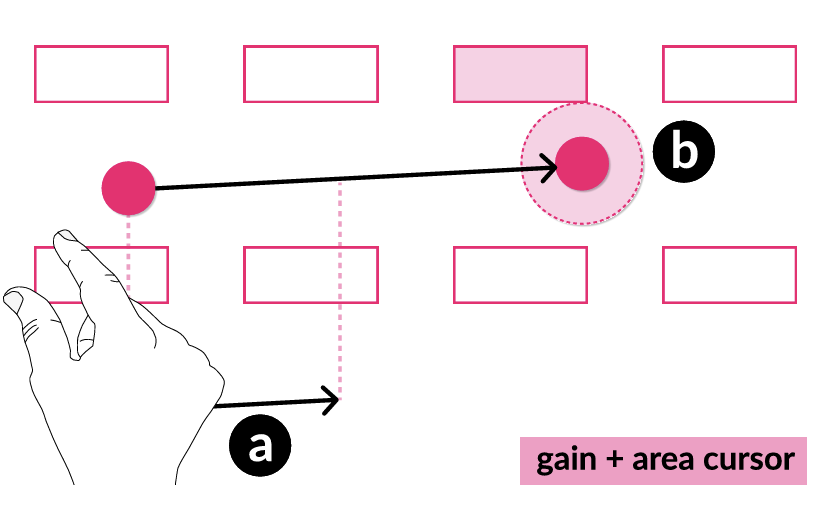 Everything to Gain: Combining Area Cursors with Increased Control-Display Gain for Fast and Accurate Touchless InputKieran Waugh, Mark McGill, and Euan FreemanIn Proceedings of the 2025 CHI Conference on Human Factors in Computing Systems, Apr 2025
Touchless displays often use mid-air gestures to control on-screen cursors for pointer interactions. Area cursors can simplify touchless cursor input by implicitly targeting nearby widgets without the cursor entering the target. However, for displays with dense target layouts, the cursor still has to arrive close to the widget, meaning the benefits of area cursors for time-to-target and effort are diminished. Through two experiments, we demonstrate for the first time that fine-tuning the mapping between hand and cursor movements (control-display gain – CDG) can address the deficiencies of area cursors and improve the performance of touchless interaction. Across several display sizes and target densities (representative of myriad public displays used in retail, transport, museums, etc), our findings show that the forgiving nature of an area cursor compensates for the imprecision of a high CDG, helping users interact more effectively with smaller and more controlled hand/arm movements.
@inproceedings{waughEverythingGainCombining2025, title = {Everything to {{Gain}}: {{Combining Area Cursors}} with Increased {{Control-Display Gain}} for {{Fast}} and {{Accurate Touchless Input}}}, shorttitle = {Everything to {{Gain}}}, booktitle = {Proceedings of the 2025 {{CHI Conference}} on {{Human Factors}} in {{Computing Systems}}}, author = {Waugh, Kieran and McGill, Mark and Freeman, Euan}, year = {2025}, month = apr, series = {{{CHI}} '25}, pages = {1--16}, publisher = {Association for Computing Machinery}, address = {New York, NY, USA}, doi = {10.1145/3706598.3714021}, urldate = {2026-02-06}, isbn = {979-8-4007-1394-1}, url = {https://dl.acm.org/doi/full/10.1145/3706598.3714021#sec-9}, } - Beyond Mute and Block: Adoption and Effectiveness of Safety Tools in Social VR, from Ubiquitous Harassment to Social SculptingMaheshya Weerasinghe, Shaun Macdonald, Cristina Fiani, Joseph O’Hagan, Mathieu Chollet, Mark McGill, and Mohamed KhamisIEEE Transactions on Visualization and Computer Graphics, May 2025
Harassment in Social Virtual Reality (SVR) is a growing concern. The current SVR landscape features inconsistent access to non-standardised safety features, with minimal empirical evidence on their real-world effectiveness, usage and impact. We examine the use and effectiveness of safety tools across 12 popular SVR platforms by surveying 100 users about their experiences of different types of harassment and their use of features like muting, blocking, personal spaces and safety gestures. While harassment remained common-including hate speech, virtual stalking, and physical harassment-many find safety features insufficient or inconsistently applied. Reactive tools like muting and blocking are widely used, largely driven by users’ familiarity from other platforms. Safety tools are also used to proactively curate individual virtual experiences, protecting users from harassment, but inadvertently leading to fragmented social spaces. We advocate for standardising proactive, rather than reactive, anti-harassment tools across platforms, and present insights into future safety feature development.
@article{weerasingheMuteBlockAdoption2025a, title = {Beyond {{Mute}} and {{Block}}: {{Adoption}} and {{Effectiveness}} of {{Safety Tools}} in {{Social VR}}, from {{Ubiquitous Harassment}} to {{Social Sculpting}}}, shorttitle = {Beyond {{Mute}} and {{Block}}}, author = {Weerasinghe, Maheshya and Macdonald, Shaun and Fiani, Cristina and O'Hagan, Joseph and Chollet, Mathieu and McGill, Mark and Khamis, Mohamed}, year = {2025}, month = may, journal = {IEEE Transactions on Visualization and Computer Graphics}, volume = {31}, number = {5}, pages = {3275--3284}, issn = {1941-0506}, doi = {10.1109/TVCG.2025.3549860}, urldate = {2026-08-05}, keywords = {Avatars,Extended Reality,Hate speech,Metaverse,Online Safety,Protection,Safety,Social networking (online),Surveys,Training,Virtual environments,Visualization,Web sites}, url = {https://ieeexplore.ieee.org/abstract/document/10922118}, } -
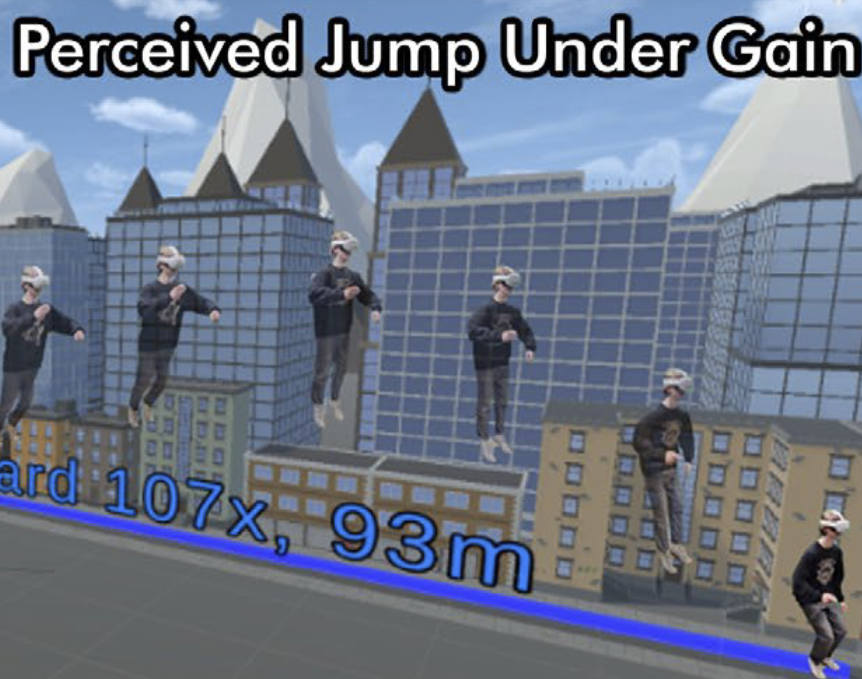 Big Frog Vibes: Jumping Superhuman Distances Forward, Vertically and Sideways in VR Using Comfortably High Translational GainGraham Wilson, Harvey Russell, Joseph O’Hagan, and Mark McGillIn 2025 IEEE International Symposium on Mixed and Augmented Reality (ISMAR), Oct 2025
Jumping is an engaging physical activity bounded by individual physical capabilities. However in Virtual Reality (VR) we can apply perceptual manipulations like translational gain to real jumps, amplifying the user’s apparent capabilities - jumping higher and further than is possible in reality. Prior work has focused on imperceptible gains, but this greatly limits the range of available experiences users can engage in, and designers can create. Research outside of jumping has shown that higher, clearly noticeable gains can still be comfortable, engaging and usable in VR. Therefore, in this paper, we evaluate (\mathrmN=18) the maximal comfortable gain applied to three jump types: forward, vertical, and sideways. We found, for the majority of participants, high gains (>100 \mathrmx) are not only comfortable but made users feel enhanced whilst retaining jump ownership, deriving guidelines on the extent to which we can amplify real jumps to feel superhuman in virtuality.
@inproceedings{wilsonBigFrogVibes2025, title = {Big {{Frog Vibes}}: {{Jumping Superhuman Distances Forward}}, {{Vertically}} and {{Sideways}} in {{VR Using Comfortably High Translational Gain}}}, shorttitle = {Big {{Frog Vibes}}}, booktitle = {2025 {{IEEE International Symposium}} on {{Mixed}} and {{Augmented Reality}} ({{ISMAR}})}, author = {Wilson, Graham and Russell, Harvey and O'Hagan, Joseph and McGill, Mark}, year = {2025}, month = oct, pages = {261--271}, issn = {2473-0726}, doi = {10.1109/ISMAR67309.2025.00038}, urldate = {2026-02-06}, keywords = {Augmented reality,Dynamics,Games,Guidelines,Jumping,Manipulator dynamics,Perceptual Manipulation,Safety,Superhuman,Translational Gain,Virtual Reality}, url = {https://ieeexplore.ieee.org/abstract/document/11220390}, } -
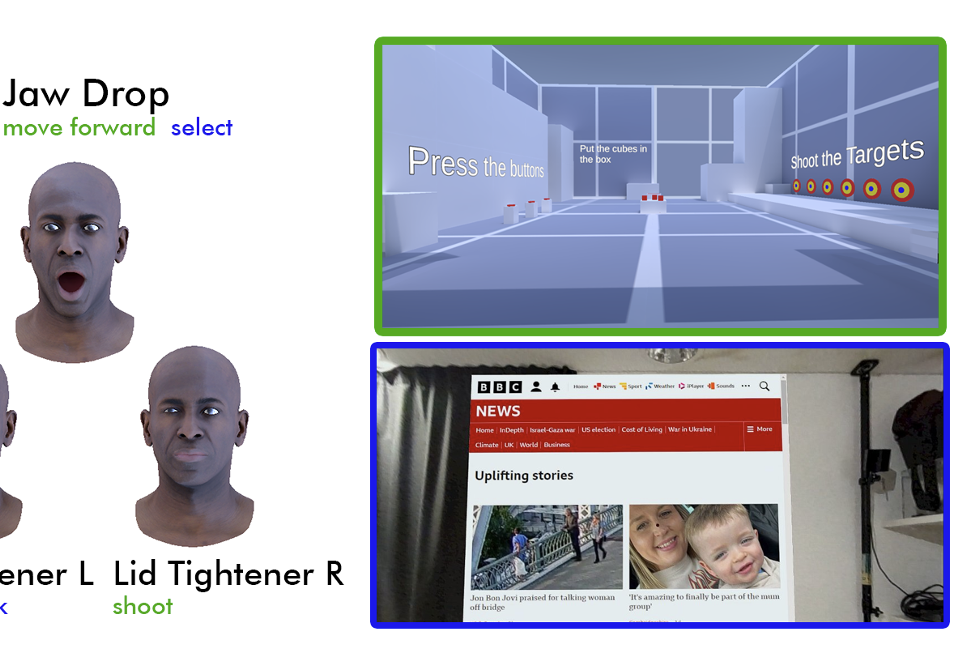 InterFACE: Establishing a Facial Action Unit Input Vocabulary for Hands-Free Extended Reality Interactions, From VR Gaming to AR Web BrowsingGraham Wilson, Jamie McCready, Euan Freeman, Florian Mathis, Harvey Russell, and Mark McGillIn Proceedings of the 2025 CHI Conference on Human Factors in Computing Systems, Apr 2025
Extended Reality (XR) interactions often rely on spatial hand or controller inputs - necessitating dexterous wrist, hand and finger movements including pressing virtual buttons, pinching to select, and performing hand gestures. However, there are scenarios where such dependencies may render XR devices and apps inaccessible to users - from situational/temporary impairments such as encumbrance, to physical motor impairments. In this paper, we contribute to a growing literature considering facial input as an alternative. In a user study (N=20) we systematically evaluate the usability of 53 Facial Action Units in VR, deriving a set of optimal (comfort, effort, performance) FAUs for interaction. We then use these facial inputs to drive and evaluate (N=10) two demonstrator apps: VR locomotion, and AR web browsing, showcasing how close facial interaction can get to existing baselines, and demonstrating that FAUs offer a viable, generalizable input modality for XR devices.
@inproceedings{wilsonInterFACEEstablishingFacial2025, title = {{{InterFACE}}: {{Establishing}} a {{Facial Action Unit Input Vocabulary}} for {{Hands-Free Extended Reality Interactions}}, {{From VR Gaming}} to {{AR Web Browsing}}}, shorttitle = {{{InterFACE}}}, booktitle = {Proceedings of the 2025 {{CHI Conference}} on {{Human Factors}} in {{Computing Systems}}}, author = {Wilson, Graham and McCready, Jamie and Freeman, Euan and Mathis, Florian and Russell, Harvey and McGill, Mark}, year = {2025}, month = apr, series = {{{CHI}} '25}, pages = {1--23}, publisher = {Association for Computing Machinery}, address = {New York, NY, USA}, doi = {10.1145/3706598.3713694}, urldate = {2026-02-06}, isbn = {979-8-4007-1394-1}, url = {https://dl.acm.org/doi/full/10.1145/3706598.3713694}, } -
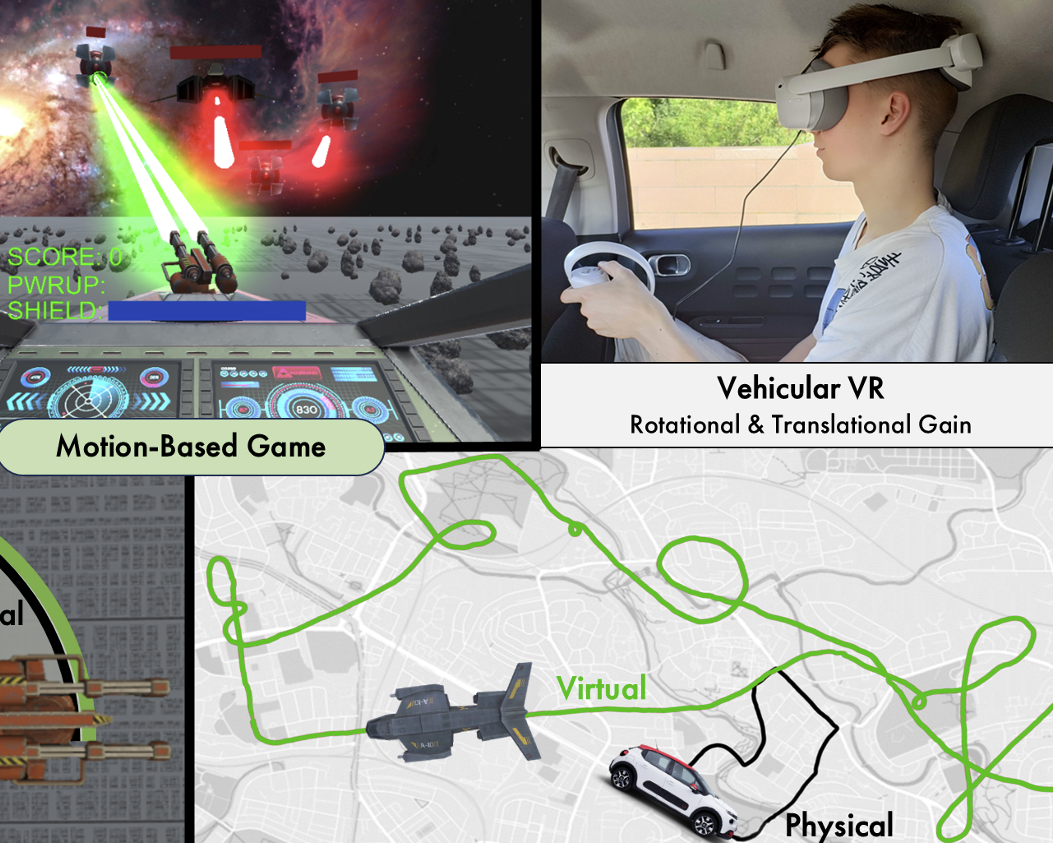 The Spin Doctor: Leveraging Insensitivity to Passive Rotational & Translational Gain For Unbounded Motion-Based VR ExperiencesGraham Wilson, Katharina Margareta Theresa Pöhlmann, David Al Baiaty Suarez, Mark McGill, and Stephen Anthony BrewsterIn Proceedings of the 2025 CHI Conference on Human Factors in Computing Systems, Apr 2025
Rotational gain has been studied largely under active self-motion, where users control their own movement. In multiple VR scenarios, the user is under passive self-motion: their body is moved by a training simulator, a motorised chair, or a vehicle-based VR application. Users may be less sensitive to manipulation under passive motion - especially when engaged in a secondary task - meaning motion experiences could be expanded by high gains and even opposed virtual-physical motion. We identified both the perceptible and maximum comfortable thresholds of rotational gain when passively turned in a motorised chair, with and without a task, for the first time. We then applied those thresholds to an ’unbounded’ in-car VR game where the user experiences an entirely different route to their physical movement. We provide the first guidelines for creating enhanced passive motion experiences and open the design space to new applications not restricted by physical motion.
@inproceedings{wilsonSpinDoctorLeveraging2025a,
  title = {The {{Spin Doctor}}: {{Leveraging Insensitivity}} to {{Passive Rotational}} \& {{Translational Gain For Unbounded Motion-Based VR Experiences}}},
  shorttitle = {The {{Spin Doctor}}},
  booktitle = {Proceedings of the 2025 {{CHI Conference}} on {{Human Factors}} in {{Computing Systems}}},
  author = {Wilson, Graham and P{\"o}hlmann, Katharina Margareta Theresa and Al Baiaty Suarez, David and McGill, Mark and Brewster, Stephen Anthony},
  year = {2025},
  month = apr,
  series = {{{CHI}} '25},
  pages = {1--19},
  publisher = {Association for Computing Machinery},
  address = {New York, NY, USA},
  doi = {10.1145/3706598.3713455},
  urldate = {2026-02-06},
  isbn = {979-8-4007-1394-1},
  url = {https://dl.acm.org/doi/full/10.1145/3706598.3713455#sec-9},
}


2024
- Don’t Record My Private pARts: Understanding The Role of Sensitive Contexts and Privacy Perceptions in Influencing Attitudes Towards Everyday Augmented Reality Sensor UsageMelvin Abraham, Mohamed Khamis, and Mark McGillIn 2024 IEEE International Symposium on Mixed and Augmented Reality (ISMAR), Oct 2024
Everyday Augmented Reality (AR) headsets come with an array of sensing capabilities. Users wearing these headsets for extended periods may prefer specific sensors to remain inactive in some contexts for privacy and sensitivity reasons. Currently, the contexts in which users wish to limit sensor data collection are unclear. To explore this, we conducted a survey (\mathrmN=100), collecting 552 scenarios to understand which situations users wish to restrict or completely block data collection by specific sensors or combinations on their AR headset. Our results show the sensitive contexts can be classified into seven categories: 1) presence of confidential information; 2) risk of data quantification; 3) expectation of solitude; 4) rules prohibiting data collection; 5) modesty and nudity; 6) home environments; and 7) outdoor public locations. Our results provide insights into privacy-invasive contexts when people want to limit and restrict their AR sensors, building towards automating permission configurations during the prolonged use of everyday AR headsets.
@inproceedings{abrahamDontRecordMy2024, title = {Don't {{Record My Private pARts}}: {{Understanding The Role}} of {{Sensitive Contexts}} and {{Privacy Perceptions}} in {{Influencing Attitudes Towards Everyday Augmented Reality Sensor Usage}}}, shorttitle = {Don't {{Record My Private pARts}}}, booktitle = {2024 {{IEEE International Symposium}} on {{Mixed}} and {{Augmented Reality}} ({{ISMAR}})}, author = {Abraham, Melvin and Khamis, Mohamed and McGill, Mark}, year = {2024}, month = oct, pages = {749--758}, issn = {2473-0726}, doi = {10.1109/ISMAR62088.2024.00090}, urldate = {2026-02-06}, keywords = {access control,Arrays,Attitude control,Augmented reality,Buildings,context,data access,Data collection,Headphones,location,permissions,privacy,Privacy,sensitive contexts,Sensitivity,Sensors,Surveys}, url = {https://ieeexplore.ieee.org/abstract/document/10765487}, } -
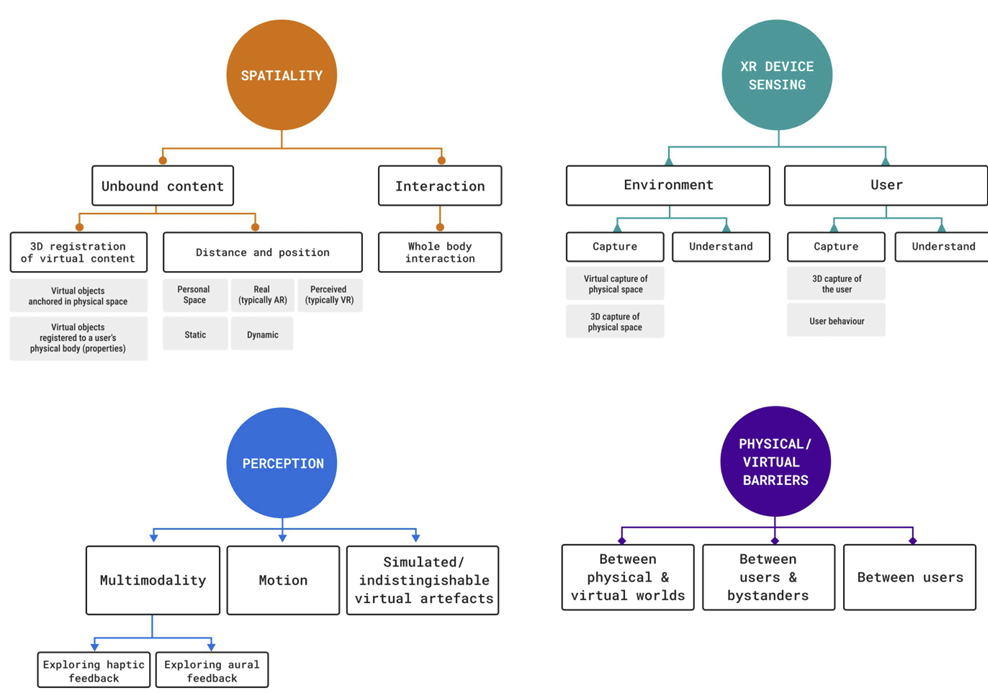 What Makes XR Dark? Examining Emerging Dark Patterns in Augmented and Virtual Reality through Expert Co-DesignVeronika Krauß, Pejman Saeghe, Alexander Boden, Mohamed Khamis, Mark McGill, Jan Gugenheimer, and Michael NebelingACM Transactions on Computer-Human Interaction, Aug 2024
Dark patterns are deceptive designs that influence a user’s interactions with an interface to benefit someone other than the user. Prior work has identified dark patterns in windows, icons, menus, and pointer (WIMP) interfaces and ubicomp environments, but how dark patterns can manifest in Augmented and Virtual Reality (collectively XR) requires more attention. We therefore conducted 10 co-design workshops with 20 experts in XR and deceptive design. Our participants co-designed 42 scenarios containing dark patterns, based on application archetypes presented in recent HCI/XR literature. In the co-designed scenarios, we identified 10 novel dark patterns in addition to 39 existing ones, as well as 10 examples in which specific characteristics associated with XR potentially amplified the effect dark patterns could have on users. Based on our findings and prior work, we present a classification of XR-specific properties that facilitate dark patterns: perception, spatiality, physical/virtual barriers, and XR device sensing. We also present the experts’ assessments of the likelihood and severity of the co-designed scenarios and highlight key aspects they considered for this evaluation, for example, technological feasibility, ease of upscaling and distributing malicious implementations, and the application’s context of use. Finally, we discuss means to mitigate XR dark patterns and support regulatory bodies to reduce potential harms.
@article{kraussWhatMakesXR2024a, title = {What {{Makes XR Dark}}? {{Examining Emerging Dark Patterns}} in {{Augmented}} and {{Virtual Reality}} through {{Expert Co-Design}}}, shorttitle = {What {{Makes XR Dark}}?}, author = {Krau{\ss}, Veronika and Saeghe, Pejman and Boden, Alexander and Khamis, Mohamed and McGill, Mark and Gugenheimer, Jan and Nebeling, Michael}, year = {2024}, month = aug, journal = {ACM Transactions on Computer-Human Interaction}, volume = {31}, number = {3}, pages = {32:1--32:39}, issn = {1073-0516}, doi = {10.1145/3660340}, urldate = {2026-08-05}, url = {https://dl.acm.org/doi/full/10.1145/3660340}, } - A Critical Review of Virtual and Extended Reality Immersive Police Training: Application Areas, Benefits & VulnerabilitiesLena Podoletz, Mark McGill, David McIlhatton, Jill Marshall, Niamh Healy, and Leonie Maria TanczerIn Proceedings of the 30th ACM Symposium on Virtual Reality Software and Technology, Oct 2024
Virtual and Extended Reality (VR/XR) headsets have promised to enhance police training through the delivery of immersive simulations able to be conducted anywhere, anytime. However, little consideration has been given to reviewing the evidenced benefits and potential issues posed by XR police training. In this paper, we summarise the evidenced usage and benefits of XR police training through a formative targeted literature review (n=41 publications). We then reflect on the prospective technical, security, social and legal issues posed by XR police training, identifying four areas where issues or vulnerabilities exist: training content, trainees and trainers, systems and devices, and state and institutional stakeholders. We highlight significant concerns around e.g. the validity of training; the psychological impact and risks of trauma; the safety and privacy risks posed to trainees and trainers; and the risks to policing institutions. We aim to encourage end-user communities (e.g. police forces) to more openly reflect on the risks of immersive training, so we can ultimately move towards transparent, validated, trusted training that is evidenced to improve policing outcomes.
@inproceedings{podoletzCriticalReviewVirtual2024, title = {A {{Critical Review}} of {{Virtual}} and {{Extended Reality Immersive Police Training}}: {{Application Areas}}, {{Benefits}} \& {{Vulnerabilities}}}, shorttitle = {A {{Critical Review}} of {{Virtual}} and {{Extended Reality Immersive Police Training}}}, booktitle = {Proceedings of the 30th {{ACM Symposium}} on {{Virtual Reality Software}} and {{Technology}}}, author = {Podoletz, Lena and McGill, Mark and McIlhatton, David and Marshall, Jill and Healy, Niamh and Tanczer, Leonie Maria}, year = {2024}, month = oct, series = {{{VRST}} '24}, pages = {1--21}, publisher = {Association for Computing Machinery}, address = {New York, NY, USA}, doi = {10.1145/3641825.3687707}, urldate = {2026-02-06}, isbn = {979-8-4007-0535-9}, url = {https://dl.acm.org/doi/abs/10.1145/3641825.3687707}, } - A Viewpoint on the Societal Impact of Everyday Augmented Reality, and the Need for Perceptual Human RightsOct 2024
@misc{ohaganViewpointSocietalImpact2024,
  type = {Conference {{Proceedings}}},
  title = {A {{Viewpoint}} on the {{Societal Impact}} of {{Everyday Augmented Reality}}, and the {{Need}} for {{Perceptual Human Rights}}},
  author = {O'Hagan, Joseph and Gugenheimer and Mathis, Florian and Bonner, Jolie and Jones, Richard and McGill, Mark},
  year = {2024},
  journal = {IEEE Security and Privacy},
  url = {https://ieeexplore.ieee.org/document/10411715/},
  urldate = {2024-01-05},
  langid = {english},
}

2023
-
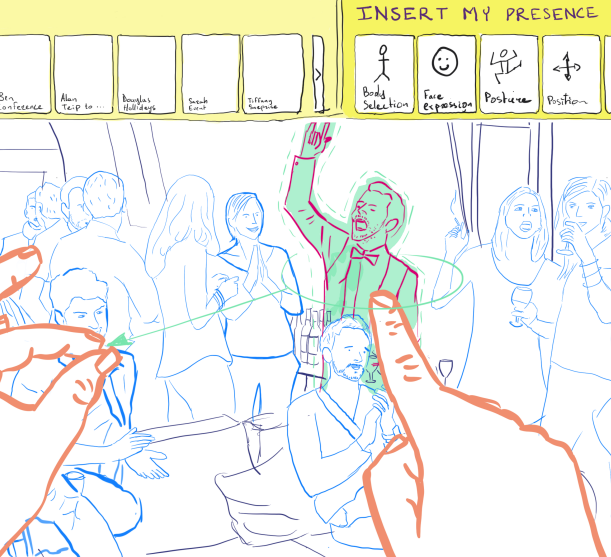 Memory Manipulations in Extended RealityElise Bonnail, Wen-Jie Tseng, Mark McGill, Eric Lecolinet, Samuel Huron, and Jan GugenheimerIn Proceedings of the 2023 CHI Conference on Human Factors in Computing Systems, Oct 2023
Human memory has notable limitations (e.g., forgetting) which have necessitated a variety of memory aids (e.g., calendars). As we grow closer to mass adoption of everyday Extended Reality (XR), which is frequently leveraging perceptual limitations (e.g., redirected walking), it becomes pertinent to consider how XR could leverage memory limitations (forgetting, distorting, persistence) to induce memory manipulations. As memories highly impact our self-perception, social interactions, and behaviors, there is a pressing need to understand XR Memory Manipulations (XRMMs). We ran three speculative design workshops (n=12), with XR and memory researchers creating 48 XRMM scenarios. Through thematic analysis, we define XRMMs, present a framework of their core components and reveal three classes (at encoding, pre-retrieval, at retrieval). Each class differs in terms of technology (AR, VR) and impact on memory (influencing quality of memories, inducing forgetting, distorting memories). We raise ethical concerns and discuss opportunities of perceptual and memory manipulations in XR.
@inproceedings{bonnailMemoryManipulationsExtended2023, title = {Memory {{Manipulations}} in {{Extended Reality}}}, booktitle = {Proceedings of the 2023 {{CHI Conference}} on {{Human Factors}} in {{Computing Systems}}}, author = {Bonnail, Elise and Tseng, Wen-Jie and McGill, Mark and Lecolinet, Eric and Huron, Samuel and Gugenheimer, Jan}, year = {2023}, series = {{{CHI}} '23}, doi = {10.1145/3544548.3580988}, urldate = {2023-05-14}, url = {https://eprints.gla.ac.uk/292234/}, copyright = {All rights reserved}, isbn = {978-1-4503-9421-5}, keywords = {Augmented Reality,Extended Reality,Perceptual Manipulations,Speculative Design,Virtual Reality,XR Memory Manipulations}, file = {C:\Users\Mark\Dropbox\Zotero\Bonnail et al_2023_Memory Manipulations in Extended Reality.pdf}, videopreview = {https://www.youtube.com/watch?v=1uBWIlhcFPs} } -
 When Filters Escape the Smartphone: Exploring Acceptance and Concerns Regarding Augmented Expression of Social Identity for Everyday ARIn ACM Symposium on Virtual Reality Software and Technology (VRST 2023), Oct 2023
Mass adoption of Everyday Augmented Reality (AR) glasses will enable pervasive augmentation of our expression of social identity through AR filters, transforming our perception of self and others. However, despite filters’ prominent and often problematic usage in social media, research has yet to reflect on the potential impact AR filters might have when brought into everyday life. Informed by our survey of 300 existing popular AR filters used on Snapchat, Instagram and Tiktok, we conducted an AR-in-VR user study where participants (N=24) were exposed to 18 filters across six categories. We evaluated the social acceptability of these augmentations around others and attitudes towards an individual’s augmented self.Our findings highlight 1) how users broadly respected another individual’s augmented self; 2) positive use cases, such as supporting the presentation of gender identity; and 3) tensions around applying AR filters to others (e.g. censorship, changing protected characteristics) and their impact on self-perception (e.g. perpetuating unrealistic beauty standards). We raise questions regarding the rights of individuals to augment and be augmented that provoke the need for further consideration of AR augmentations in society.
@inproceedings{bonnerWhenFiltersEscape2023, title = {When {{Filters Escape}} the {{Smartphone}}: {{Exploring Acceptance}} and {{Concerns Regarding Augmented Expression}} of {{Social Identity}} for {{Everyday AR}}}, shorttitle = {When {{Filters Escape}} the {{Smartphone}}}, booktitle = {{{ACM Symposium}} on {{Virtual Reality Software}} and {{Technology}} ({{VRST}} 2023)}, author = {Bonner, Jolie and Mathis, Florian and O'Hagan, Joseph and McGill, Mark}, year = {2023}, url = {https://dl.acm.org/doi/10.1145/3611659.3615707}, doi = {10.1145/3611659.3615707}, urldate = {2023-08-26}, langid = {english}, file = {C:\Users\Mark\Zotero\storage\83F8H3V9\304939.html}, } -
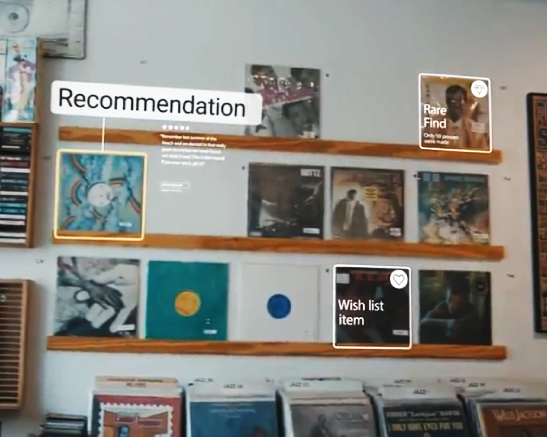 Augmenting People, Places & Media: The Societal Harms Posed by Everyday Augmented Reality, and the Case for Perceptual Human RightsIn Proceedings of the 22nd International Conference on Mobile and Ubiquitous Multimedia, Oct 2023
Everyday Augmented Reality (AR) displays, with wearable, fashionable, all-day form factors, may one day supplant our reliance on physical displays, heralding new capabilities in augmented intelligence and perception, communication, productivity, and more. Such technology has the potential to become as fundamental to our daily lives as smartphones are today, empowering users, communities, business, governments, and others to alter, augment, diminish or otherwise mediate our perception of reality. For social good, this technology can enable augmenting expression of social identity to better represent our ‘authentic’ self, and virtually enhancing real-world social spaces to encourage greater community ownership and social cohesion. For social harm however, everyday AR could facilitate and amplify manipulation, information disorder (e.g. dis-information), censorship and coercion in our day-to-day experience of reality. In this essay, we consider some of the key societal changes (and ethical challenges) posed by the adoption of everyday AR, and argue that everyday AR will provoke the need for new human rights to be considered alongside proposed neurorights and existing and envisaged digital human rights, around: who can mediate reality (perceptual autonomy); what elements of reality are permissible to alter/augment (perceptual agency); and governing permissible intent regarding why we augment the user’s perception of reality, in particular considering tensions in cognitive autonomy (e.g. manipulation) and perceptual integrity (e.g. information disorder).
@inproceedings{ohaganAugmentingPeoplePlaces2023, title = {Augmenting {{People}}, {{Places}} \& {{Media}}: {{The Societal Harms Posed}} by {{Everyday Augmented Reality}}, and the {{Case}} for {{Perceptual Human Rights}}}, shorttitle = {Augmenting {{People}}, {{Places}} \& {{Media}}}, booktitle = {Proceedings of the 22nd {{International Conference}} on {{Mobile}} and {{Ubiquitous Multimedia}}}, author = {O'Hagan, Joseph and Gugenheimer, Jan and Bonner, Jolie and Mathis, Florian and McGill, Mark}, year = {2023}, series = {{{MUM}} '23}, doi = {10.1145/3626705.3627782}, urldate = {2024-01-05}, url = {https://dl.acm.org/doi/10.1145/3626705.3627782}, isbn = {9798400709210}, keywords = {Augmented Reality,Censorship,Human Rights,Identity;,Manipulation,Perceptual Manipulation}, } -
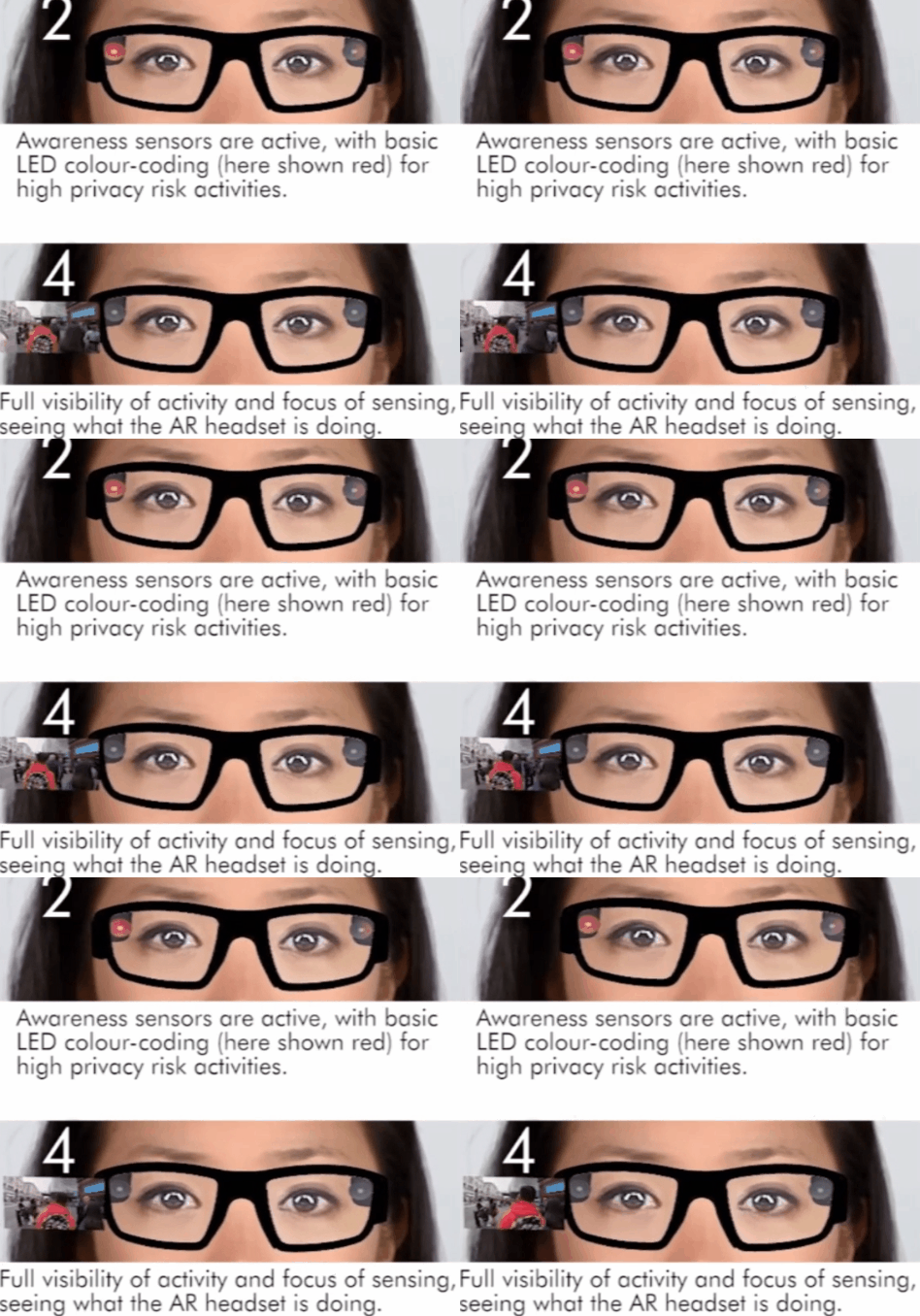 Privacy-Enhancing Technology and Everyday Augmented Reality: Understanding Bystanders’ Varying Needs for Awareness and ConsentJoseph O’Hagan, Pejman Saeghe, Jan Gugenheimer, Daniel Medeiros, Karola Marky, Mohamed Khamis, and Mark McGillProceedings of the ACM on Interactive, Mobile, Wearable and Ubiquitous Technologies, Oct 2023
Fundamental to Augmented Reality (AR) headsets is their capacity to visually and aurally sense the world around them, necessary to drive the positional tracking that makes rendering 3D spatial content possible. This requisite sensing also opens the door for more advanced AR-driven activities, such as augmented perception, volumetric capture and biometric identification - activities with the potential to expose bystanders to significant privacy risks. Existing Privacy-Enhancing Technologies (PETs) often safeguard against these risks at a low level e.g., instituting camera access controls. However, we argue that such PETs are incompatible with the need for always-on sensing given AR headsets’ intended everyday use. Through an online survey (N=102), we examine bystanders’ awareness of, and concerns regarding, potentially privacy infringing AR activities; the extent to which bystanders’ consent should be sought; and the level of granularity of information necessary to provide awareness of AR activities to bystanders. Our findings suggest that PETs should take into account the AR activity type, and relationship to bystanders, selectively facilitating awareness and consent. In this way, we can ensure bystanders feel their privacy is respected by everyday AR headsets, and avoid unnecessary rejection of these powerful devices by society.
@article{ohaganPrivacyEnhancingTechnologyEveryday2023, title = {Privacy-{{Enhancing Technology}} and {{Everyday Augmented Reality}}: {{Understanding Bystanders}}' {{Varying Needs}} for {{Awareness}} and {{Consent}}}, shorttitle = {Privacy-{{Enhancing Technology}} and {{Everyday Augmented Reality}}}, author = {O'Hagan, Joseph and Saeghe, Pejman and Gugenheimer, Jan and Medeiros, Daniel and Marky, Karola and Khamis, Mohamed and McGill, Mark}, year = {2023}, journal = {Proceedings of the ACM on Interactive, Mobile, Wearable and Ubiquitous Technologies}, number = {4}, doi = {10.1145/3569501}, urldate = {2023-01-25}, url = {https://dl.acm.org/doi/10.1145/3569501}, copyright = {All rights reserved}, keywords = {Altered Reality,Augmented Reality,Biometrics,Bystanders,Extended Perception,Privacy}, talk = {https://www.youtube.com/watch?v=6fVHBMZS_LU} } -
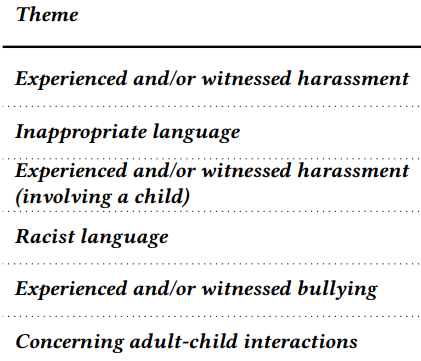 User Reviews as a Reporting Mechanism for Emergent Issues Within Social VR CommunitiesJoseph O’Hagan, Florian Mathis, and Mark McGillIn Proceedings of the 22nd International Conference on Mobile and Ubiquitous Multimedia, Oct 2023
Social virtual reality (VR) will potentially change online communities, transforming how people meet, interact, and socialise online. However, issues surrounding the growing threat of harassment (from verbal to cyber-physical assault) posed within social VR platforms are increasingly being noted within research.Yet, while prior research has successfully captured singular qualitative insights (e.g. identifying individual types of harassment or target user groups) it is essential that systems be developed to monitor emergent threats to community cohesion, including harassment, in a platform independent manner. In this paper, we explore whether user reviews are a valid and useful source of data around harassment incidences in social VR, a crucial first step towards platform agnostic, large scale and longitudinal monitoring of emerging harassment in social VR communities through user reviews posted about social VR applications.. We analysed 1000 user reviews posted on the Meta Quest store page for the social VR platform Rec Room and found 114 reviews report experiencing and/or witnessing harassment during use. Our results establish the validity of analysing user reviews as a means of monitoring harassment in social VR communities and we close by discussing their use in large scale, longitudinal monitoring systems.
@inproceedings{ohaganUserReviewsReporting2023,
  title = {User {{Reviews}} as a {{Reporting Mechanism}} for {{Emergent Issues Within Social VR Communities}}},
  booktitle = {Proceedings of the 22nd {{International Conference}} on {{Mobile}} and {{Ubiquitous Multimedia}}},
  author = {O'Hagan, Joseph and Mathis, Florian and McGill, Mark},
  year = {2023},
  series = {{{MUM}} '23},
  doi = {10.1145/3626705.3627780},
  urldate = {2024-01-05},
  url = {https://dl.acm.org/doi/10.1145/3626705.3627780},
  isbn = {9798400709210},
  keywords = {Harassment,Social Virtual Reality,User Reviews,Virtual Environments,Virtual Reality},
}


2022
-
 The Dark Side of Perceptual Manipulations in Virtual RealityWen-Jie Tseng, Elise Bonnail, Mark McGill, Mohamed Khamis, Eric Lecolinet, Samuel Huron, and Jan GugenheimerIn Proceedings of the 2022 CHI Conference on Human Factors in Computing Systems, Oct 2022
“Virtual-Physical Perceptual Manipulations” (VPPMs) such as redirected walking and haptics expand the user’s capacity to interact with Virtual Reality (VR) beyond what would ordinarily physically be possible. VPPMs leverage knowledge of the limits of human perception to effect changes in the user’s physical movements, becoming able to (perceptibly and imperceptibly) nudge their physical actions to enhance interactivity in VR. We explore the risks posed by the malicious use of VPPMs. First, we define, conceptualize and demonstrate the existence of VPPMs. Next, using speculative design workshops, we explore and characterize the threats/risks posed, proposing mitigations and preventative recommendations against the malicious use of VPPMs. Finally, we implement two sample applications to demonstrate how existing VPPMs could be trivially subverted to create the potential for physical harm. This paper aims to raise awareness that the current way we apply and publish VPPMs can lead to malicious exploits of our perceptual vulnerabilities.
@inproceedings{tseng2022chi,
  title = {The Dark Side of Perceptual Manipulations in Virtual Reality},
  booktitle = {Proceedings of the 2022 {{CHI}} Conference on Human Factors in Computing Systems},
  author = {Tseng, Wen-Jie and Bonnail, Elise and McGill, Mark and Khamis, Mohamed and Lecolinet, Eric and Huron, Samuel and Gugenheimer, Jan},
  year = {2022},
  series = {{{CHI}} '22},
  doi = {10.1145/3491102.3517728},
  url = {https://dl.acm.org/doi/abs/10.1145/3491102.3517728},
  articleno = {612},
  copyright = {All rights reserved},
  isbn = {978-1-4503-9157-3},
  keywords = {physical harm,virtual-physical perceptual manipulation,VPPM,VR security},
  videopreview = {https://www.youtube.com/watch?v=uJRCchb_kAI},
}

2021
- Extended Reality (XR) and the Erosion of Anonymity and PrivacyThe IEEE Global Initiative on Ethics of Extended Reality (XR) Report, Oct 2021
This report is the result of work within the IEEE Global Initiative on Ethics of Extended Reality (XR), a multidiscipline group of industry practitioners, ethicists, academics, researchers, educators, and technology enthusiasts. It has been written to focus on a wide range of ethical issues related to XR and the erosion of anonymity and privacy. This report builds on work outlined in the “Extended Reality” chapter of the IEEE’s seminal ethics-focused publication, Ethically Aligned Design. XR is a term used to broadly refer to a suite of immersive technologies including virtual reality, augmented reality, and spatial computing. The scope of this report is the exploration of ethics-related issues in terms of anonymity and privacy of XR applications; the aim is to initiate expert-driven, multidiscipline analysis of the evolving XR Ethics requirements, with a vision to propose solutions, technologies, and standards in future updates. The set of recommendations within this report will hopefully contribute to industry conceptualization of socio-technological issues, highlight concreted recommendations, and lay the groundwork for future technical-standardization activities.
@article{mcgillExtendedRealityXR2021, title = {Extended {{Reality}} ({{XR}}) and the {{Erosion}} of {{Anonymity}} and {{Privacy}}}, author = {McGill, Mark}, year = {2021}, journal = {The IEEE Global Initiative on Ethics of Extended Reality (XR) Report}, url = {https://ieeexplore.ieee.org/document/9619999}, copyright = {All rights reserved}, keywords = {⛔ No DOI found,ethics,extended reality,industry connections,privacy,white paper,XR}, file = {C\:\\Users\\Mark\\Dropbox\\Zotero\\McGill_Mark_2021_The IEEE Global Initiative on Ethics of Extended Reality (XR) Report–Extended.pdf;C\:\\Users\\Mark\\Zotero\\storage\\KV2PWH78\\9619999.html}, } -
 Safety, Power Imbalances, Ethics and Proxy Sex: Surveying In-The-Wild Interactions Between VR Users and BystandersIn 2021 IEEE International Symposium on Mixed and Augmented Reality (ISMAR), Oct 2021
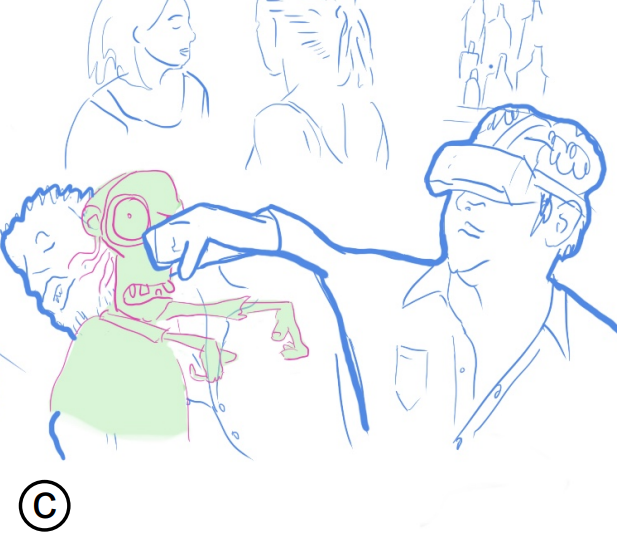
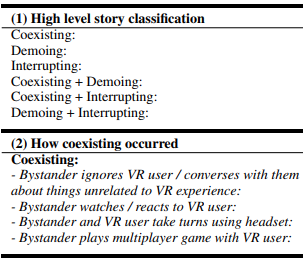
VR users and bystanders must sometimes interact, but our understanding of these interactions - their purpose, how they are accomplished, attitudes toward them, and where they break down - is limited. This current gap inhibits research into managing or supporting these interactions, and preventing unwanted or abusive activity. We present the results of the first survey (N=100) that investigates stories of actual emergent in-the-wild interactions between VR users and bystanders. Our analysis indicates VR user and bystander interactions can be categorised into one of three categories: coexisting, demoing, and interrupting. We highlight common interaction patterns and impediments encountered during these interactions. Bystanders play an important role in moderating the VR user’s experience, for example intervening to save the VR user from potential harm. However, our stories also suggest that the occlusive nature of VR introduces the potential for bystanders to exploit the vulnerable state of the VR user; and for the VR user to exploit the bystander for enhanced immersion, introducing significant ethical concerns.
@inproceedings{ohaganSafetyPowerImbalances2021a,
  title = {Safety, {{Power Imbalances}}, {{Ethics}} and {{Proxy Sex}}: {{Surveying In-The-Wild Interactions Between VR Users}} and {{Bystanders}}},
  shorttitle = {Safety, {{Power Imbalances}}, {{Ethics}} and {{Proxy Sex}}},
  booktitle = {2021 {{IEEE International Symposium}} on {{Mixed}} and {{Augmented Reality}} ({{ISMAR}})},
  author = {O'Hagan, Joseph and Williamson, Julie R. and McGill, Mark and Khamis, Mohamed},
  year = {2021},
  issn = {1554-7868},
  doi = {10.1109/ISMAR52148.2021.00036},
  url = {https://ieeexplore.ieee.org/document/9583820},
  copyright = {All rights reserved},
  keywords = {Augmented reality,Ethics,Human computer interaction (HCI),Human-centered computing,Interaction paradigms,Safety,Virtual reality},
}

2020
-
 Exploring Potentially Abusive Ethical, Social and Political Implications of Mixed Reality Research in HCIJan Gugenheimer, Mark McGill, Samuel Huron, Christian Mai, Julie Williamson, and Michael NebelingIn , Oct 2020
In recent years, Mixed Reality (MR) headsets have increasingly made advances in terms of capability, affordability and end-user adoption, slowly becoming everyday technology. HCI research typically explores positive aspects of these technologies, focusing on interaction, presence and immersive experiences. However, such technological advances and paradigm shifts often fail to consider the "dark patterns", with potential abusive scenarios, made possible by new technologies (cf. smartphone addiction, social media anxiety disorder). While these topics are getting recent attention in related fields and with the general population, this workshop is aimed at starting an active exploration of abusive, ethical, social and political scenarios of MR research inside the HCI community. With an HCI lens, workshop participants will engage in critical reviews of emerging MR technologies and applications and develop a joint research agenda to address them.
@inproceedings{Gugenheimer2020,
  title = {Exploring Potentially Abusive Ethical, Social and Political Implications of Mixed Reality Research in {{HCI}}},
  author = {Gugenheimer, Jan and McGill, Mark and Huron, Samuel and Mai, Christian and Williamson, Julie and Nebeling, Michael},
  year = {2020},
  series = {Conference on {{Human Factors}} in {{Computing Systems}} - {{Proceedings}}},
  doi = {10.1145/3334480.3375180},
  url = {https://dl.acm.org/doi/abs/10.1145/3334480.3375180},
  city = {New York, NY, USA},
  copyright = {All rights reserved},
  isbn = {978-1-4503-6819-3},
  keywords = {Abuse,Design fiction,Ethics,Mixed reality},
}

2018
-
 Violent Video Games in Virtual Reality: Re-evaluating the Impact and Rating of Interactive ExperiencesGraham Wilson, and Mark McGillCHI PLAY 2018 - Proceedings of the 2018 Annual Symposium on Computer-Human Interaction in Play, Oct 2018
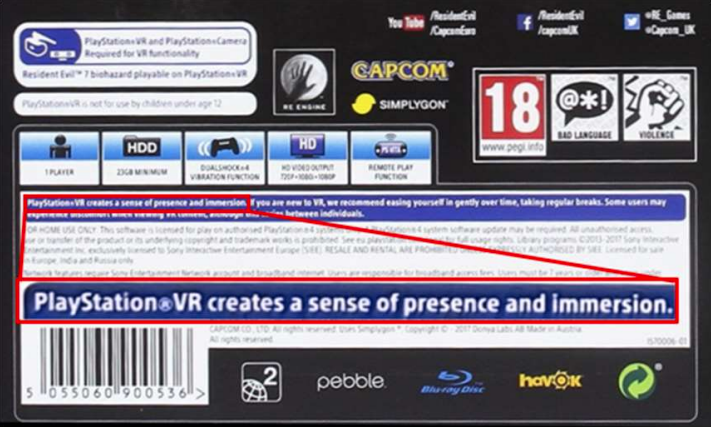
Bespoke Virtual Reality (VR) laboratory experiences can be differently affecting than traditional display experiences. With the proliferation of at-home VR headsets, these effects need to be explored in consumer media, to ensure the public are adequately informed. As yet, the organizations responsible for content descriptions and age-based ratings of consumer content do not rate VR games differently to those played on TV. This could lead to experiences that are more intense or subconsciously affecting than desired. To test whether VR and non-VR games are differently affecting, and so whether game ratings are appropriate, our research examined how participant (n=16) experience differed when playing the violent horror video game “Resident Evil 7”, viewed from a first-person perspective in PlayStation VR and on a 40” TV. The two formats led to meaningfully different experiences, suggesting that current game ratings may be unsuitable for capturing and conveying VR experiences.
@article{Wilson2018,
  title = {Violent Video Games in Virtual Reality: {{Re-evaluating}} the Impact and Rating of Interactive Experiences},
  author = {Wilson, Graham and McGill, Mark},
  year = {2018},
  journal = {CHI PLAY 2018 - Proceedings of the 2018 Annual Symposium on Computer-Human Interaction in Play},
  doi = {10.1145/3242671.3242684},
  url = {https://dl.acm.org/doi/10.1145/3242671.3242684},
  copyright = {All rights reserved},
  isbn = {9781450356244},
  keywords = {Age ratings,Video games,Violence,Virtual reality},
}

2015
-
 A Dose of Reality: Overcoming Usability Challenges in VR Head-Mounted DisplaysMark McGill, Daniel Boland, Roderick Murray-Smith, and Stephen BrewsterIn Proceedings of the 33rd Annual ACM Conference on Human Factors in Computing Systems, Oct 2015
We identify usability challenges facing consumers adopting Virtual Reality (VR) head-mounted displays (HMDs) in a survey of 108 VR HMD users. Users reported significant issues in interacting with, and being aware of their real-world context when using a HMD. Building upon existing work on blending real and virtual environments, we performed three design studies to address these usability concerns. In a typing study, we show that augmenting VR with a view of reality significantly corrected the performance impairment of typing in VR. We then investigated how much reality should be incorporated and when, so as to preserve users’ sense of presence in VR. For interaction with objects and peripherals, we found that selectively presenting reality as users engaged with it was optimal in terms of performance and users’ sense of presence. Finally, we investigated how this selective, engagement-dependent approach could be applied in social environments, to support the user’s awareness of the proximity and presence of others.
@inproceedings{mcgillDoseRealityOvercoming2015a,
  title = {A {{Dose}} of {{Reality}}: {{Overcoming Usability Challenges}} in {{VR Head-Mounted Displays}}},
  shorttitle = {A {{Dose}} of {{Reality}}},
  booktitle = {Proceedings of the 33rd {{Annual ACM Conference}} on {{Human Factors}} in {{Computing Systems}}},
  author = {McGill, Mark and Boland, Daniel and {Murray-Smith}, Roderick and Brewster, Stephen},
  year = {2015},
  series = {{{CHI}} '15},
  doi = {10.1145/2702123.2702382},
  urldate = {2020-06-08},
  url = {https://dl.acm.org/doi/10.1145/2702123.2702382},
  copyright = {All rights reserved},
  isbn = {978-1-4503-3145-6},
  keywords = {augmented virtuality,engagement,virtual reality},
  file = {C:\Users\Mark\Dropbox\Zotero\McGill et al_2015_A Dose of Reality.pdf},
  videopreview = {https://www.youtube.com/watch?v=_PESkwbCwgc},
}
